 Bouquets · DIY kits
Three things matter. Proportion: the vase should be roughly a third to a half of the total height, and that sets the stem length. Cutting: cut at an angle to open up the drinking surface, get the stems into water immediately, and strip every leaf that would sit below the waterline. Order of work: sort into focal flowers, filler and foliage; build the frame with foliage first, place the focal flowers, then close the gaps with filler. Three beginner shapes — round, one-sided and linear — cover most of what a home needs.
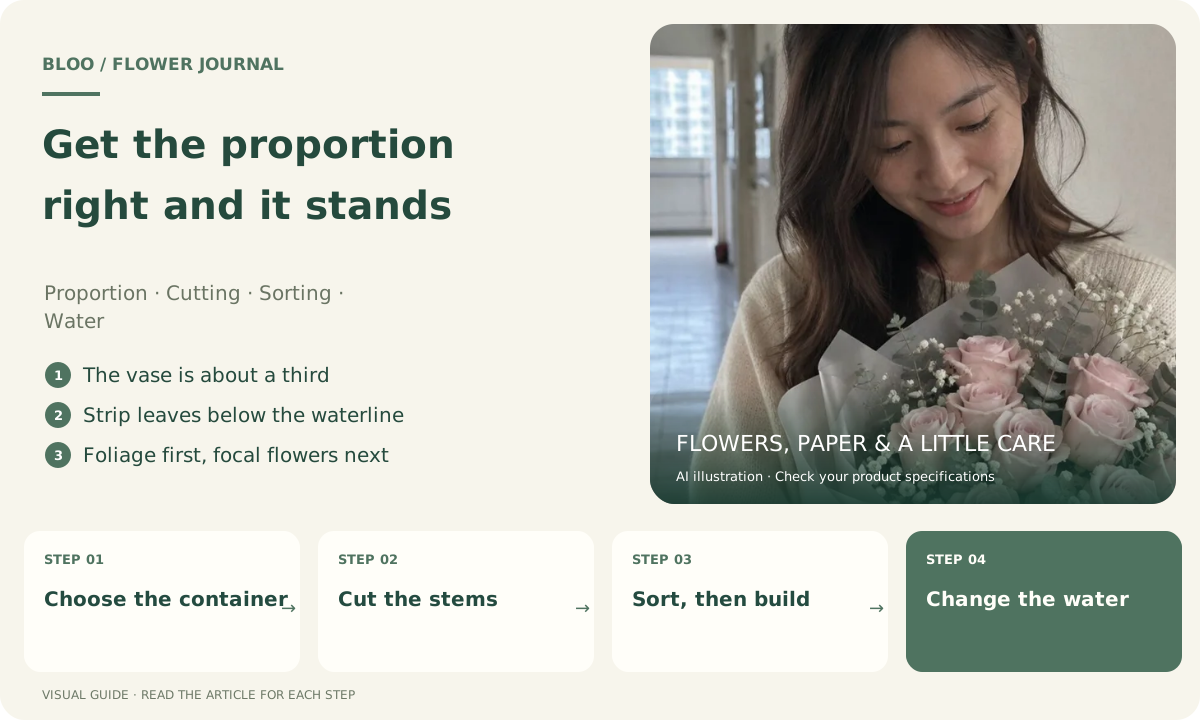
Get the proportion right and it stands
Proportion · Cutting · Sorting · Water
- 01
Choose the container
Match the mouth first, then the height
- 02
Cut the stems
At an angle, and straight into water
- 03
Sort, then build
Foliage, focal flowers, filler
- 04
Change the water
When it clouds — and trim while you are there
Check before continuing: The proportions here are a starting point rather than a specification. Different material and containers need adjusting.
Choosing a vase: proportion before style
Most home arrangements go wrong on proportion. A reliable starting point: the vase should be about a third to a half of the total height. A vase 20 cm tall sits comfortably under a finished height of 40 to 60 cm — and that is what tells you how long to cut the stems.
The mouth matters just as much and is more often overlooked. Too wide and the stems splay outwards and will not stand; too narrow and they jam together, which is neither good for the water nor good to look at. When a bouquet arrives, grip it at the base, look at how thick that bundle is, and find a container whose opening is close to it.
| Bouquet size | Vase height | Stem length | Water depth |
|---|---|---|---|
| Small | About 15 – 18 cm | A finished height of 30 – 40 cm | Two thirds of the vase |
| Standard | About 20 – 25 cm | A finished height of 45 – 60 cm | Two thirds of the vase |
| Large | About 28 – 35 cm | A finished height of 65 – 85 cm | Two thirds of the vase |
Cutting: the angle, the length and the leaves
Cutting at an angle increases the cut surface so the stem takes up water more easily, and stops the cut sitting flat against the bottom of the vase and sealing itself off. Around forty-five degrees is plenty; it does not need to be exact. Use sharp scissors or a knife rather than something blunt — crushed tissue draws water poorly.
Get the stems into water straight away rather than leaving them on the counter while you work. One step matters more than the cut itself: strip every leaf that would sit below the waterline. Submerged leaves rot, cloud the water and feed bacteria, and that is the single most common reason flowers fail early at home — far more than how neatly they were cut.
Sort before you start
Untie the bouquet and sort it into three piles: focal flowers (the largest, the ones that catch the eye), filler (smaller stems for closing gaps) and foliage. It looks like an unnecessary step, and it is what turns "arrange these flowers" from a vague task into three clear ones. Skip it and most people discover halfway through that there is no longer anywhere for the foliage to go.
The order is foliage, focal flowers, filler. Foliage builds the frame and the outline, and settles how big and what shape this arrangement will be. Focal flowers go into that frame, placed unevenly — staggered heights read far more naturally than a row. Filler goes in last to close the gaps and to hide the point where the stems visibly cross.
Three shapes to start with
There is no need for complicated forms. These three cover most places in a home, and what separates them is how many directions the arrangement will be seen from. Choosing the wrong one is the real reason many people think their own arrangements look wrong — not technique, but the arrangement being in the wrong place.
- Round: attractive from every side, for the middle of a dining table. Keep it low enough not to block the person opposite.
- One-sided: only the front matters, for a console against a wall or an entrance. Finish the back with foliage.
- Linear: few stems, emphasising height and empty space, for a narrow spot or a room where restraint is the point.
A water and trimming routine
How often you change the water matters more than how you change it. Change it when it clouds, not when it smells. Take the chance to trim a little off the stem ends at the same time — cuts gradually seal up with bacteria and air, and a fresh cut is what lets them keep drinking. Doing both together works far better than water alone.
Where it sits matters too. Keep it out of direct sun, away from air-conditioning vents and away from the heat that appliances throw off. Do not put it next to fruit either — ripening fruit gives off ethylene, which ages flowers faster. All of this is worth extra attention in Hong Kong interiors, where the air conditioning often runs all day.
When it starts to droop
A drooping head does not always mean the end; it is often a stem that has stopped drinking. Take it out, cut a centimetre or two off at an angle, put it in clean water and leave it somewhere cool for a few hours. Roses and hydrangeas usually respond well. If the inside of the stem is already discoloured or soft when you cut it, that one is genuinely finished.
An arrangement does not have to go all at once. Different material lasts different lengths of time, and filler and foliage usually outlive the focal flowers. Pull out what is spent, move the rest into a smaller vase, and there are often several more days in it — and it reads as deliberate restraint rather than as leftovers.
A small exercise before you start
Stand the bouquet, wrapping and all, next to the vase and see where the rim falls against the stems. That is the length to remove. People cut too short because they judge by eye instead of measuring once. Measure, then cut — a stem cut short cannot be put back, and ten seconds prevents it.
You might also wonder
What if I do not have a vase?
Anything watertight with an opening close to the thickness of the stem bundle: a glass bottle, a ceramic jug, a wide tumbler, even a washed-out jam jar. What matters is the proportion and the mouth, not whether the object is officially a vase. If the opening is too wide, tape a grid across it with clear tape and place the stems into the squares.
Does the water need changing every day?
Not necessarily daily, but change it as soon as it clouds rather than waiting for a smell. Trim a little off the stem ends while you are there — cuts seal up with bacteria and air, and a fresh one lets them keep drinking. And strip every leaf that would sit below the waterline; that is the most common reason flowers fail early.
Can a foam-based arrangement be moved into a vase?
Yes, but accept that the stems have already been shortened. Foam arrangements have stems cut short to seat into the foam, so once removed they usually only suit a low container. Pull each stem straight out rather than twisting it, then re-cut at an angle and get it into water. The shape will not be what it was, so it is more realistic to treat it as a new, smaller arrangement.
Sources and further reading
Product specifications, fees and availability follow the details confirmed when ordering. Spotted something that needs correcting? Contact BLOO