 Bouquets · DIY kits
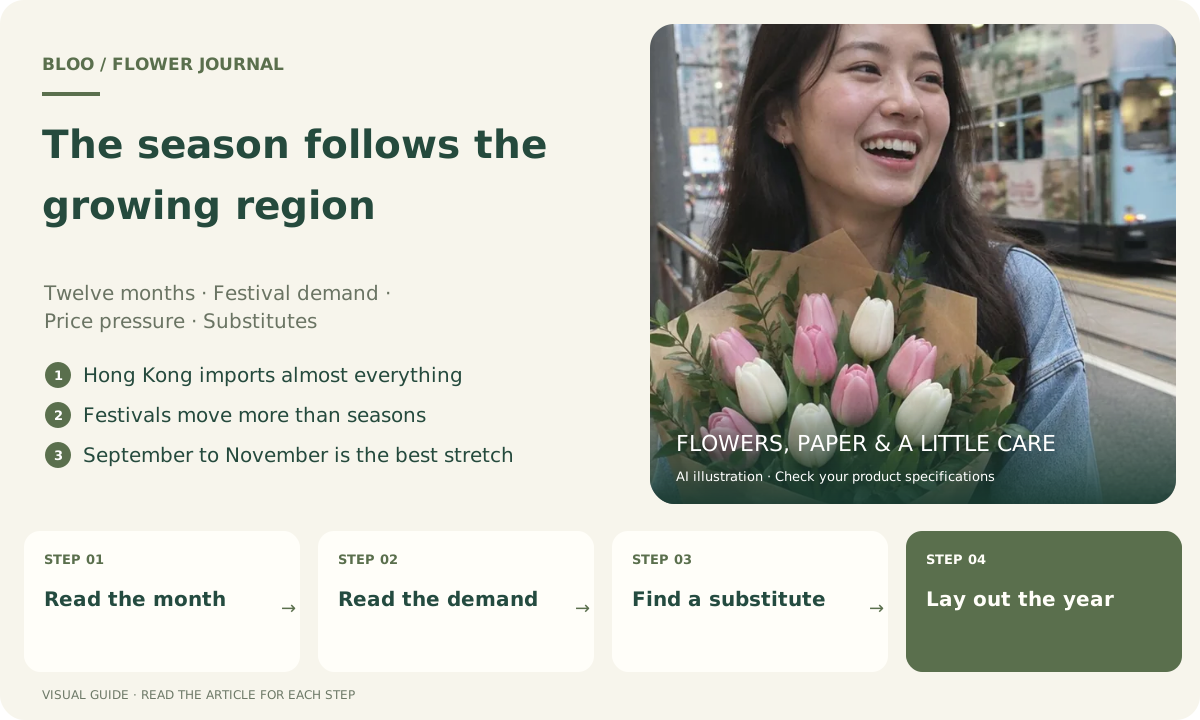
Almost all cut flowers in Hong Kong are imported — mainly from Yunnan, the Netherlands, Kenya, Japan and Taiwan — so "in season" here tracks the growing regions rather than the local climate. In practice: January and February belong to Lunar New Year material; March to May is the tulip, hydrangea and peony window; June to August leans on sunflowers and heat-tolerant stems; September to November, once the heat drops, is when roses and lisianthus are at their best; December is festive material and imported roses. Festival demand moves prices more than the season itself does.
The season follows the growing region
Twelve months · Festival demand · Price pressure · Substitutes
- 01
Read the month
Start with what is usually around
- 02
Read the demand
Festivals are what push the price
- 03
Find a substitute
Seasonal and good beats out-of-season
- 04
Lay out the year
Mark the one or two that hit a peak
Check before continuing: Supply varies by supplier, by weather in the growing regions and by year. The table describes the usual pattern rather than guaranteeing availability.
What "in season" means in Hong Kong
Hong Kong has limited farmland and its own cut-flower output cannot supply the retail market, so almost everything is imported — chiefly from Yunnan, the Netherlands, Kenya, Japan and Taiwan. Which means "in season" here is not decided by Hong Kong’s weather but by the growing seasons of those regions.
That has practical consequences. First, some material is available all year and what changes is quality and price rather than availability. Second, Hong Kong’s heat and humidity affect how stems behave after arrival, so in summer heat tolerance becomes a selection criterion even when something is technically obtainable. Third, distance sets freshness: Yunnan is a few days away, an air shipment from the Netherlands considerably longer.
Twelve months, one table
What follows is what is commonly around each month in the Hong Kong market, and which way demand pushes. Supply varies by supplier, by weather in the growing regions and by the year, so this describes the usual pattern rather than guaranteeing it. What is actually available when you order is what counts.
| Month | Commonly in season | Demand that month | Price pressure |
|---|---|---|---|
| January | Phalaenopsis, chrysanthemum, narcissus, pussy willow, tulips | Stocking up before Lunar New Year | Rising |
| February | Roses, peach blossom, tree peony, tulips | Valentine’s Day and Lunar New Year | The year’s peak |
| March | Tulips, lisianthus, carnations, hydrangea | Quiet after the festivals | Easing |
| April | Hydrangea, early peonies, tulips, roses | Easter and spring weddings | Steady |
| May | Peonies, carnations, hydrangea, roses | Mother’s Day | Rises before Mother’s Day |
| June | Sunflowers, lilies, anthurium, hydrangea | Some graduation ceremonies | Steady |
| July | Sunflowers, anthurium, tropical material | Quiet | Among the year’s lower points |
| August | Sunflowers, gladioli, heat-tolerant material | Quiet | Among the year’s lower points |
| September | Lisianthus, chrysanthemum, roses, dahlias | Mid-Autumn | Steady |
| October | Roses, lisianthus, dahlias, chrysanthemum | Autumn weddings | Steady |
| November | Roses, lisianthus, dried material | Graduation season begins | Edging up |
| December | Roses, conifer, poinsettia, tulips | Graduations, Christmas and New Year’s Eve | Rising |
What the local climate does after arrival
Hong Kong’s mean relative humidity runs high year-round, and summer temperatures sit above 30°C for long stretches. Neither suits cut flowers: heat speeds up opening and ageing, while damp favours bacteria and mould. The same material delivered in July and in November can behave noticeably differently indoors.
It also explains why September to November is often reckoned the best stretch of the year for flowers here. The heat drops, the humidity eases, material such as roses and lisianthus is visibly better, and no large festival is pushing prices up in those weeks.
Festivals move prices, not seasons
One thing stands out from that table: price tracks festival demand far more closely than it tracks whether something is in season. February roses are not unusually hard to grow — they are dear because the whole world wants roses in the same week. July sunflowers are inexpensive not only because they are in season but because no major flower-giving festival falls that month.
That is directly useful when planning. If the date can move, avoiding a festival window usually saves more than changing the variety does. If it cannot — a birthday, a wedding or an anniversary that happens to sit near a festival — then order early and buy back the choice instead.
When what you want is out of season
Rather than paying a premium for an out-of-season stem in ordinary condition, swap it for one that is in season and in good condition. The pairings below are chosen for how they look and feel, not for botanical relation.
- Peonies out of season: double-form roses or dahlias give a similar full head.
- Hydrangea priced high: mass smaller stems into a block — clustered carnations or baby’s breath.
- Tulips hard to get in summer: lisianthus or gladioli carry a similar line.
- Sunflowers dear in winter: yellow roses or gerberas hold the same colour weight.
Using the calendar to plan a year
Write out the fixed flower dates in your year — birthdays, anniversaries, Mother’s Day, anything that will need congratulating — then read each one against the table above. Two things become obvious quickly: which of them collide with a festival peak, and which happen to fall in the months when the flowers are at their best.
For the ones that collide, order early or consider sending a day or two ahead. For the ones that land between September and November, it can be worth putting a little more of the budget there — the same money buys the best condition of the year in those months, and no peak surcharge applies.
A small exercise before you plan
Mark the dates you will genuinely be sending flowers this year, then write the "price pressure" column from the table beside each one. Looked at across the whole year, usually only one or two fall in a peak and the rest sit in steady or quiet months. Knowing which one or two need handling early is far more use than memorising twelve months of flower names.
You might also wonder
Are in-season flowers always cheaper?
Usually, but not always. Price comes from supply and demand together, and festival demand often outweighs the season. February roses are in season and are the dearest of the year, because the whole world wants roses that week. To save money, avoiding a festival window is generally more effective than choosing for season.
Are any cut flowers grown in Hong Kong?
Some, but not many. Hong Kong has little farmland and local cut-flower output cannot supply the retail market, so almost everything is imported — chiefly from Yunnan, the Netherlands, Kenya, Japan and Taiwan. That is why "in season" here follows the growing regions rather than the local climate.
Can I still order something out of season?
Usually yes, but on two conditions: it costs more, and the condition may not be what you hoped. Rather than paying a premium for an ordinary out-of-season stem, swap in something seasonal and good — double-form roses or dahlias for peonies, lisianthus for tulips. If that particular flower is the point of the gesture, order early and confirm availability with the florist first.
Sources and further reading
Product specifications, fees and availability follow the details confirmed when ordering. Spotted something that needs correcting? Contact BLOO